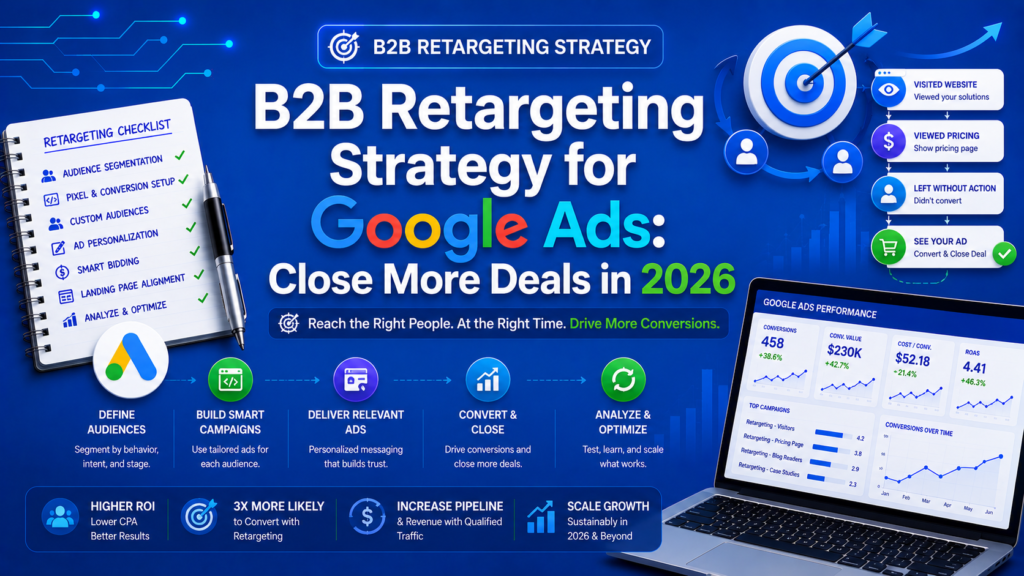
Featured Snippet Target: A B2B retargeting strategy for Google Ads segments website visitors by intent level and serves sequential ads that match their buyer journey stage: (1) awareness retargeting for blog readers with educational content ads, (2) consideration retargeting for product/case study viewers with comparison and social proof ads, (3) decision retargeting for pricing page visitors with demo/consultation offers, and (4) customer expansion retargeting for existing clients with upsell content.
Ninety-five percent of B2B website visitors leave without converting. They read your content, browse your case studies, even check your pricing page and then they disappear back into the internet.
Retargeting brings them back. But most B2B retargeting is lazy: show the same “Book a Demo” ad to everyone for 30 days. This wastes budget on people who are not ready to buy and annoys people who already converted.
Smart B2B retargeting matches the message to the prospect’s stage in the buying journey. Here is the multi-touch strategy that turns anonymous website visitors into qualified pipeline.
The B2B Retargeting Architecture
Audience Segmentation by Intent Level
Create four audience segments based on website behavior:
Tier 1: Awareness visitors (lowest intent)
- Visited blog posts or educational content
- Did not visit product, pricing, or case study pages
- Session duration under 3 minutes
- Audience size: typically 60-70% of total traffic
Tier 2: Consideration visitors (medium intent)
- Visited product pages, case studies, or comparison pages
- Session duration over 3 minutes
- Viewed 3+ pages in one session
- Audience size: typically 20-25% of total traffic
Tier 3: Decision visitors (high intent)
- Visited pricing page, demo page, or contact page
- Started but did not complete a form
- Audience size: typically 5-10% of total traffic
Tier 4: Existing customers
- Logged into your product or visited customer-only pages
- Purpose: upsell, cross-sell, and retention
Sequential Ad Strategy by Tier
Tier 1 ads (Days 1-30): Educate and build trust
Promote your best educational content: guides, webinars, research reports
Ad copy focuses on solving their problem, not selling your product
Goal: move them to Tier 2 by driving deeper engagement
Budget allocation: 25% of retargeting spend
Tier 2 ads (Days 1-21): Demonstrate value
Promote case studies matching their industry or use case
Show comparison content (vs. competitors or vs. status quo)
Include customer testimonials and social proof
Goal: move them to Tier 3 by building confidence
Budget allocation: 35% of retargeting spend
Tier 3 ads (Days 1-14): Convert
Direct CTAs: book a demo, schedule consultation, start free trial
Use urgency and specificity: “See how [your product] handles [their specific use case]”
Show ROI-focused messaging with specific numbers
Goal: conversion (form fill, demo, meeting)
Budget allocation: 40% of retargeting spend
Frequency Capping
B2B retargeting requires careful frequency management. Too many impressions creates annoyance, not conversions.
|
Tier |
Daily Cap |
Weekly Cap |
Duration |
|---|---|---|---|
|
Tier 1 (Awareness) |
2 impressions |
10 impressions |
30 days |
|
Tier 2 (Consideration) |
3 impressions |
15 impressions |
21 days |
|
Tier 3 (Decision) |
4 impressions |
20 impressions |
14 days |
Campaign Setup in Google Ads
Display Retargeting Campaigns
Best for: Brand awareness and Tier 1/Tier 2 nurturing.
Setup:
- Create separate campaigns for each tier
- Use responsive display ads with multiple headlines, descriptions, and images
- Exclude low-quality placements (mobile games, made-for-ads sites) using placement exclusion lists
- Target only desktop and tablet for B2B (unless your data shows mobile converts)
YouTube Retargeting Campaigns
Best for: Tier 2 prospects who need more education.
Setup:
- In-stream ads: 30-60 second videos showing case studies or product demos
- In-feed ads: Educational video content appearing in YouTube search results
- Target your Tier 2 audience specifically
- Include companion banners for additional visibility
Search Retargeting (RLSA)
Best for: Tier 3 prospects actively searching for solutions.
Remarketing Lists for Search Ads (RLSA) let you bid higher when past visitors search relevant keywords:
- Apply your retargeting audiences as “targeting” layers on search campaigns
- Increase bids 25-50% for Tier 3 visitors searching relevant terms
- Create specific ad copy for retargeting audiences: “Welcome back—ready to see [product] in action?”
Performance Max Retargeting
Best for: Reaching prospects across all Google surfaces.
Add your retargeting audiences as audience signals in Performance Max campaigns. Google’s AI then prioritizes showing ads to these warm prospects across Search, Display, YouTube, Gmail, and Discover.
Advanced Retargeting Tactics
Account-Based Retargeting
For named target accounts, combine website retargeting with company-level targeting:
- Upload your target account list to Google Ads (customer match by domain)
- Create campaigns that only target employees of specific companies who have visited your site
- Serve highly personalized ads mentioning their industry challenges
Cross-Channel Retargeting Coordination
Coordinate your Google Ads retargeting with other platforms:
- A prospect visits your site (tracked by Google)
- Day 1-3: Google Display retargeting with educational content
- Day 3-7: LinkedIn retargeting with case study content
- Day 7-14: Google Search retargeting (RLSA) with higher bids
- Day 14-21: Email nurture sequence (if you have their email)
- Day 21-30: Final Google retargeting push with direct CTA
Exclusion Lists (Critical for B2B)
Exclusions prevent wasted spend:
- Exclude converters. Once someone fills out a form, stop showing them conversion ads (switch to customer onboarding or upsell ads)
- Exclude employees. Filter your company’s IP range and domain
- Exclude competitors. If you can identify competitor domains in your traffic, exclude them
- Exclude irrelevant visitors. Visitors who only viewed your careers page or blog posts on unrelated topics
Performance Benchmarks
|
Metric |
B2B Retargeting Benchmark |
|---|---|
|
Click-through rate (Display) |
0.7-1.5% |
|
Click-through rate (YouTube) |
1.5-3.0% |
|
Conversion rate (Tier 3) |
3-8% |
|
Cost per click (Display) |
$1-$4 |
|
Cost per click (RLSA) |
$3-$8 |
|
View-through conversion rate |
0.5-2.0% |
|
Retargeting ROAS |
5:1 to 15:1 |
Budget Recommendations
|
Company Size |
Monthly Retargeting Budget |
Expected Results |
|---|---|---|
|
Small (< 10K monthly visitors) |
$1,000-$2,500 |
5-15 conversions |
|
Mid-market (10K-50K visitors) |
$2,500-$8,000 |
15-50 conversions |
|
Enterprise (50K+ visitors) |
$8,000-$25,000 |
50-150 conversions |
Retargeting typically delivers the highest ROAS of any paid campaign type in B2B. Start with 10-15% of your total Google Ads budget allocated to retargeting and increase as you see results.
The Bottom Line
B2B retargeting is not about pestering people into conversion. It is about guiding qualified prospects through a complex buying journey with relevant, timely messaging that builds confidence in your solution.
The companies that segment audiences by intent, match creative to buying stage, and coordinate across channels turn their retargeting into a reliable pipeline generator.
At Expert Written Marketing, we build multi-touch retargeting systems that integrate with your full marketing stack. Every impression moves a prospect closer to becoming a customer.
Ready to build your B2B retargeting system? Get a free campaign audit from Expert Written Marketing.