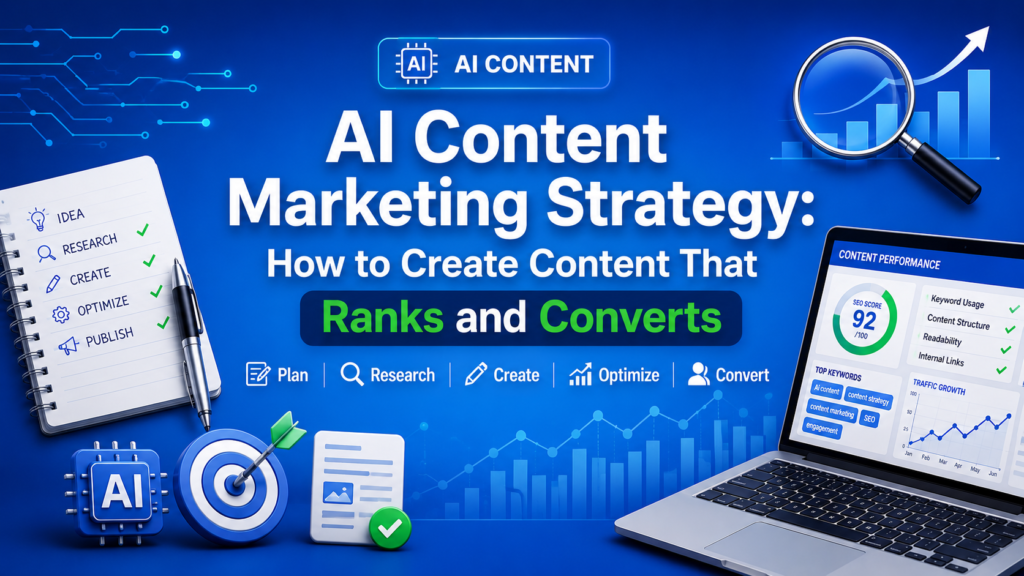
An AI content marketing strategy uses artificial intelligence tools to re‐search topics, generate first drafts, optimize for SEO, and personalize content at scale—while human
experts provide strategic direction, fact-checking, brand voice, and the E-E-A-T signals Google requires for ranking. The best approach combines AI efficiency (10x content output) with human expertise (quality, credibility, and conversion optimization).
Ninety percent of AI-generated content fails to rank on Google. Not because AI cannot write—it can.
But because ranking requires something AI alone cannot provide: genuine expertise, original insights, and the strategic thinking that turns content into pipeline.
The companies dominating B2B search results in 2026 are not choosing between AI and human content. They are combining both in a systematic framework that delivers expert quality at AI speed.
This is the exact AI content marketing strategy we use at Expert Written Marketing. It is responsible for ranking dozens of B2B clients on page one of Google.
The AI Content Problem Nobody Talks About
The internet is now flooded with AI-generated content. ChatGPT, Claude, and dozens of writing tools have made it trivially easy to produce 2,000 words on any topic in minutes.
The result? A content quality crisis.
The saturation problem. When everyone can produce content at the same speed, content volume is no longer a competitive advantage. Google’s index is growing faster than ever, but user search behavior is shifting to AI overviews and direct answers.
The sameness problem. AI models are trained on existing internet content. They produce statistically average content—the median of everything already written. Your content blends in with thousands of similar articles.
The trust problem. Google’s E-E-A-T framework (Experience, Expertise, Authoritativeness, Trustworthiness) explicitly rewards content demonstrating first-hand experience and genuine expertise. Pure AI content cannot demonstrate experience it has never had.
The Expert Written Content Framework
Our framework solves all three problems. It uses AI for what AI does best (speed, research, optimization) and humans for what humans do best (expertise, strategy, originality).
Phase 1: AI-Powered Research and Topic Discovery
Before writing a single word, AI tools map the entire content landscape around your target topic.
Step 1: Keyword cluster analysis. Use AI SEO tools to identify not just individual keywords, but topic clusters. For example, “B2B content marketing” connects to subtopics like strategy, measurement, distribution, and tools. Map the entire cluster before planning content.
Step 2: SERP analysis. AI analyzes the top 10 ranking pages for your target keyword:
– Average word count and content depth
– Heading structure and topic coverage
– Questions answered and questions missed
– Content format (listicle, guide, comparison, case study)
Step 3: Content gap identification. The most valuable part of AI research is finding what existing content does NOT cover. These gaps are your ranking opportunity. If every competitor covers “5 content marketing strategies” but nobody addresses implementation challenges, that is your angle.
Step 4: Audience question mining. AI scrapes Google’s People Also Ask, Reddit threads, Quora questions, and industry forums to compile every question your audience is asking about the topic. Your content should answer questions competitors have not addressed.
Phase 2: Strategic Content Planning
This is where human expertise takes the lead.
Define the content angle. AI can research what exists. Humans decide what is missing. Your content angle should combine:
– A unique perspective based on real experience
– Data or case studies competitors do not have
– A contrarian viewpoint backed by evidence
– A more practical, actionable approach than what ranks
Choose the content format. Not every topic needs a 3,000-word guide. Match format to search intent:
– Informational queries → comprehensive guides with clear structure
– Commercial queries → comparison posts with honest evaluations
– Transactional queries → product-focused pages with strong CTAs
– Navigational queries → brand-focused content with trust signals
Plan the expert elements. Decide in advance where human expertise adds the most value:
– Personal anecdotes and case study data
– Contrarian opinions supported by first-hand experience
– Technical depth that AI cannot fabricate accurately
– Specific recommendations with reasoning
Phase 3: AI-Assisted Draft Creation
Now AI accelerates the writing process.
Use AI for the first draft structure. Provide the AI with your outline, target keyword, content angle, and voice guidelines. Let it produce a structured first draft that covers the topic comprehensively.
AI excels at:
– Generating comprehensive outlines from your topic brief
– Expanding bullet points into full paragraphs
– Creating transition sentences between sections
– Suggesting subheadings and formatting improvements
– Producing multiple variations of introductions and conclusions
AI should NOT handle:
– Case study details (these must be real)
– Specific client results or data points
– Technical claims that require verification
– Brand voice and personality elements
– Strategic recommendations requiring judgment
Phase 4: Expert Human Editing and Enhancement
This is where content goes from generic to exceptional.
The expert editing process:
1. Fact verification. Check every claim, statistic, and recommendation. AI confidently states inaccurate information. Every factual claim needs a verifiable source.
2. Experience injection. Add real examples, case studies, and personal insights. Replace generic statements like “companies see improved results” with specific claims like “our client [Company X] increased organic traffic 340% in 6 months using this approach.”
3. Voice alignment. Adjust tone, vocabulary, and sentence structure to match your brand voice. Your content should be instantly recognizable as yours.
4. Strategic depth. AI provides breadth but rarely depth. Go deeper on the most valuable sections. Add the nuance, caveats, and practical considerations that only experience provides.
5. CTA integration. Weave calls to action naturally throughout the content—not just at the end.
Phase 5: SEO Optimization
With the content finalized, optimize for search engines.
On-page SEO checklist:
– Primary keyword in title, H1, first 100 words, and 2-3 H2s
– Secondary keywords distributed naturally throughout (avoid stuffing)
– Meta description under 160 characters with primary keyword and compelling hook
– URL slug contains primary keyword (short, clean, no dates)
– Internal links to 3-5 related pages on your site
– External links to 2-3 authoritative sources
– Image alt tags with descriptive, keyword-relevant text
– Schema markup (Article, FAQ, HowTo as appropriate)
Content structure for featured snippets:
– Include a definition-style paragraph in the first 200 words
– Use numbered lists for process-oriented queries
– Create comparison tables for “vs” or “best” queries
– Add an FAQ section targeting People Also Ask questions
Readability optimization:
– Short paragraphs (2-4 sentences maximum)
– Subheadings every 200-300 words
– Bold key takeaways and statistics
– Use transitional phrases to maintain flow
Phase 6: Content Distribution and Amplification
Publishing is not the finish line—it is the starting point.
Distribution strategy:
– Email list. Send a dedicated email for pillar content, a digest for shorter posts
– Social media. Adapt key points into platform-native formats (LinkedIn articles, X threads, Instagram
carousels)
– Internal linking. Update existing content to link to the new post
– Outreach. Notify anyone mentioned or linked in the content
– Repurposing. Turn key sections into YouTube scripts, podcast talking points, and slide decks
The Content Calendar Framework
Here is the publishing cadence we recommend for B2B companies:
Total: approximately 14 posts per month. With the AI-assisted framework, this is achievable with one content strategist and one subject matter expert.
Measuring Content Marketing ROI
Track these metrics monthly:
Leading indicators (1-3 months):
– Organic impressions and click-through rate
– Keyword rankings movement
– Time on page and scroll depth
– Email subscribers from content
Lagging indicators (3-6 months):
– Organic traffic growth
– Leads generated from organic content
– Pipeline influenced by content touchpoints
– Revenue attributed to content marketing
The benchmark: B2B content marketing should achieve a 3:1 ROI within 12 months. If you are spending $10,000/month on content, you should see $30,000 in attributed pipeline by month 12.
Tools We Recommend
AI writing assistance: Claude, ChatGPT (for drafts and ideation)
SEO optimization: Clearscope, Surfer SEO, MarketMuse
Keyword research: Ahrefs, SEMrush, Google Search Console
Content analytics: Google Analytics 4, Search Console, Hotjar
Content management: WordPress with Yoast SEO or RankMath
The Bottom Line
AI content marketing is not about choosing between AI and human expertise. It is about combining them strategically to produce content that ranks, converts, and builds your brand as the authority in your space.
The framework is simple: AI for speed and scale, humans for expertise and strategy, systems for consistency and measurement.
At Expert Written Marketing, this framework is our core operating system. It is how we help B2B companies build content engines that generate organic pipeline month after month.
Want to see this framework in action? Book a content strategy session (https://expertwrittenmarketing.com) with Expert Written Marketing.