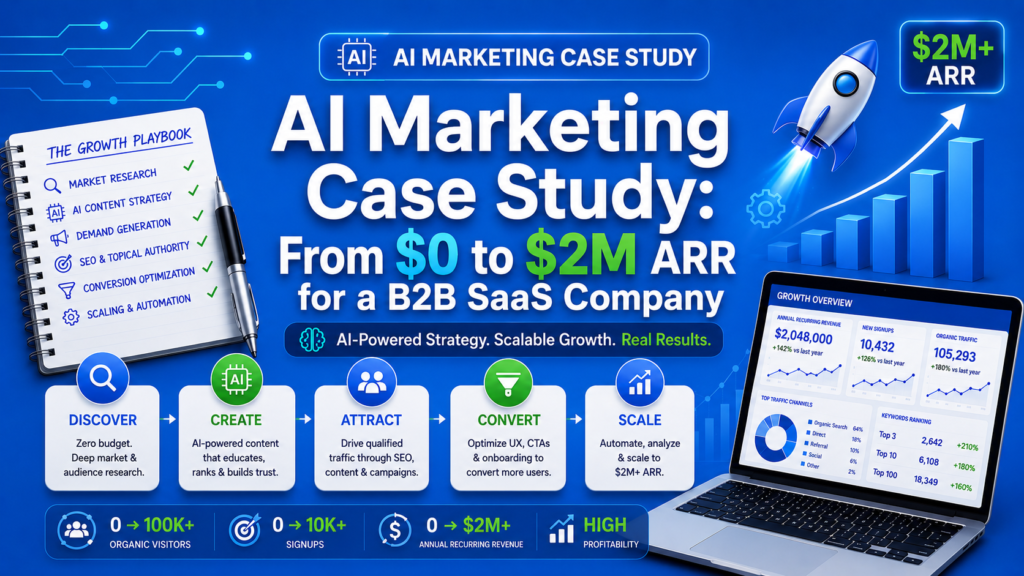
In this AI marketing case study, a B2B SaaS company grew from $0 to $2M ARR in 18 months using three core strategies: (1) AI-optimized content marketing that generated 45,000 monthly organic visitors, (2) Google Ads campaigns with offline conversion tracking that reduced cost per qualified lead by 62%, and (3) AI-powered email nurture sequences that converted 12% of MQLs to closed-won deals.
This is the story of how we took a B2B SaaS company from zero revenue to $2 million in annual recurring revenue in 18 months using AI-powered marketing. No vanity metrics. No cherry-picked data points. Just the full strategy, the exact numbers, and the lessons learned.
The client asked us to anonymize their name, so we will call them CloudSync—a project management platform for mid-market professional services firms.
The Starting Point
When CloudSync came to Expert Written Marketing, they had a product and a problem:
What they had:
– A solid product with strong early customer feedback
– $200K in seed funding allocated to marketing
– A two-person marketing team (one content marketer, one demand gen specialist)
– Zero organic traffic
– Zero brand awareness in their target market
What they needed:
– A repeatable pipeline of qualified leads
– Organic search presence for their core product category
– A marketing engine that would scale without proportional headcount increases
Their target market: Professional services firms (consulting, accounting, legal) with 50-500 employees.
The Strategy: Three AI-Powered Pillars
We designed a three-pillar strategy that would work within their budget and team constraints.
Pillar 1: AI-Optimized Content Engine
The goal: Build organic search presence from zero to become the authority in their niche within 12 months.
The approach:
We identified three topic clusters aligned with CloudSync’s product value:
1. Project management for professional services
2. Resource planning and utilization
3. Client collaboration and delivery
For each cluster, we built:
– 1 comprehensive pillar page (3,000+ words)
– 10-12 cluster articles (1,500-2,000 words each)
– FAQ pages targeting long-tail questions
The AI role: We used our Expert Written Content Framework:
– AI tools researched every target keyword, analyzed competing content, and identified content gaps
– AI generated structured first drafts based on detailed content briefs
– Human experts added real insights from the professional services industry, client examples, and practical advice
– AI optimized the final content for SEO using Clearscope scoring
Content production rate: 12 articles per month with a two-person team—3x what they could have produced without AI assistance.
The results over 18 months:
|
Metric |
Month 3 |
Month 6 |
Month 12 |
Month 18 |
|
Monthly organic traffic |
2,100 |
8,400 |
28,000 |
45,000 |
|
Organic |
45 |
180 |
620 |
1,100 |
|
Blog-generated MQLs/month |
15 |
55 |
140 |
210 |
|
Domain Authority |
12 |
22 |
38 |
45 |
Key insight: The first three months felt slow. Organic SEO always does. But the compound effect kicked in around month 4, and growth accelerated every month after that. By month 12, organic content was generating more qualified leads than paid ads.
Pillar 2: AI-Optimized Google Ads
The goal: Generate immediate qualified leads while organic content builds.
The approach: We implemented the full B2B Google Ads architecture
Campaign structure:
– Tier 1 (60% budget): High-intent search campaigns targeting “[solution] for professional services,”
“project management software consulting firms,” and competitor names
– Tier 2 (25% budget): Educational content campaigns driving whitepaper and webinar registrations
– Tier 3 (15% budget): Performance Max campaigns with customer match audience signals
The AI role:
– Google’s AI-powered Smart Bidding (Target CPA, then Value-Based Bidding)
– AI-generated ad copy variations tested through Responsive Search Ads
– Automated bid adjustments based on time of day, device, and audience signals
The critical move: Offline conversion tracking.
We integrated CloudSync’s HubSpot CRM with Google Ads, sending pipeline data back to Google:
– Form fill = $5
– MQL = $25
– SQL = $100
– Opportunity = $500
– Closed-Won = $8,000 (their average deal value)
After six weeks of data, Google’s algorithm started optimizing for revenue, not just leads. The impact was dramatic.
Google Ads results over 18 months:
|
Metric |
Month 1-3 |
Month 4-6 |
Month 7-12 |
Month 13-18 |
|
Monthly ad |
$8,000 |
$12,000 |
$15,000 |
$15,000 |
|
Cost per lead |
$180 |
$120 |
$85 |
$68 |
|
Cost per SQL |
$680 |
$410 |
$280 |
$215 |
|
Monthly SQLs |
12 |
29 |
54 |
70 |
|
Pipeline generated |
$96,000 |
$232,000 |
$432,000 |
$560,000 |
Key insight: Offline conversion tracking was the single biggest lever. Once we shifted from optimizing for form fills to optimizing for revenue, cost per SQL dropped 62% over 18 months while volume increased 6x.
Pillar 3: AI-Powered Email Nurture
The goal: Convert the growing lead database into qualified pipeline through automated, personalized nurture sequences.
The approach: We built a multi-track nurture system using HubSpot with AI optimization:
Track 1: New lead welcome sequence (5 emails, 14 days)
– Welcome + value proposition
– Industry-specific case study
– Educational content (matched to the topic they engaged with)
– Product comparison guide
– Consultation offer
Track 2: Engaged lead nurture (ongoing)
– Weekly content digest with AI-selected content based on browsing behavior
– Monthly product update emails
– Event and webinar invitations
Track 3: Re-engagement sequence (triggered after 30 days of inactivity)
– New content highlight
– Industry trend or research report
– Direct ask: “Still interested in solving [problem]?”
The AI role:
– Seventh Sense optimized send times for each individual contact
– AI analyzed engagement patterns to assign leads to the appropriate track
– Dynamic content blocks personalized email content based on industry, company size, and engagement history
– Predictive lead scoring identified when leads were ready for sales handoff
Email nurture results:
|
Metric |
Result |
|
Average open rate |
38% (industry average: 22%) |
|
Average click rate |
5.2% (industry average: 2.8%) |
|
MQL to SQL conversion |
28% |
|
SQL to Opportunity conversion |
42% |
|
Opportunity to Closed-Won |
32% |
|
Overall MQL to Closed-Won |
12.1% |
Key insight: Personalization drove the results. When leads received content matched to their specific industry and engagement behavior, conversion rates doubled compared to generic nurture sequences.
The Revenue Breakdown
Here is how the $2M ARR broke down by channel:
|
Channel |
Leads |
SQLs |
Closed-Won |
ARR Generated |
|
Organic content |
2,520 |
310 |
85 |
$680,000 |
|
Google Ads |
1,680 |
215 |
62 |
$496,000 |
|
Email nurture |
(influenced) |
(influenced) |
(influenced) |
$520,000 |
|
Direct/referral |
420 |
95 |
38 |
$304,000 |
|
Total |
4,620 |
620 |
185 |
$2,000,000 |
Note: Email nurture influenced deals across all channels. The $520K attributed to email represents deals where email was a critical touchpoint in the buyer journey but the lead originated from another channel.
Total Investment vs. Return
|
Investment Category |
18-Month Total |
|
Expert Written Marketing retainer |
$180,000 |
|
Google Ads spend |
$216,000 |
|
Marketing tools (HubSpot, Clearscope, etc.) |
$48,000 |
|
Internal marketing team salaries |
$270,000 |
|
Total marketing investment |
$714,000 |
|
Total ARR generated |
$2,000,000 |
|
Marketing ROI |
2.8x |
The 2.8x ROI is calculated on first-year ARR only. Given that SaaS retention rates average 85%+, the lifetime value of these customers makes the actual ROI significantly higher.
Lessons Learned
Lesson 1: AI accelerates but does not replace strategy. Every AI tool we used was guided by human strategic decisions. AI cannot determine your market positioning, choose your target audience, or craft a differentiated value proposition. Humans set the direction; AI executes faster.
Lesson 2: Offline conversion tracking is not optional. The moment we connected CRM data to Google Ads, performance improved across every metric. If your B2B company runs Google Ads without offline conversion tracking, you are leaving money on the table.
Lesson 3: Content compounds, ads do not. Organic content generated increasing returns over time—every new article added to the existing library’s authority and traffic. Ads generated consistent returns but required ongoing spend. The healthiest B2B marketing programs invest in both.
Lesson 4: Personalization at scale is the AI advantage. The biggest wins came from using AI to personalize at a scale no human team could manage—thousands of email contacts getting individually optimized send times, content recommendations, and messaging.
Lesson 5: Give it time. Months 1-3 were anxiety-inducing. Organic traffic was minimal, ad costs were high (the algorithm was learning), and leads were few. By month 6, the system was generating predictable pipeline. By month 12, it was a machine.
Can You Replicate This?
Yes—with the right approach. The exact playbook will vary based on your market, budget, and starting point. But the principles are universal:
1. Build AI-optimized content clusters for organic authority
2. Run Google Ads with offline conversion tracking from day one
3. Implement AI-powered email nurture to convert leads into pipeline
4. Be patient with organic, aggressive with paid, and rigorous with measurement
At Expert Written Marketing, this is what we do for every B2B client. The tools and tactics evolve, but the framework is proven.
Want results like these for your B2B company? Schedule a strategy call (https://expertwrittenmarketing.com) with Expert Written Marketing.