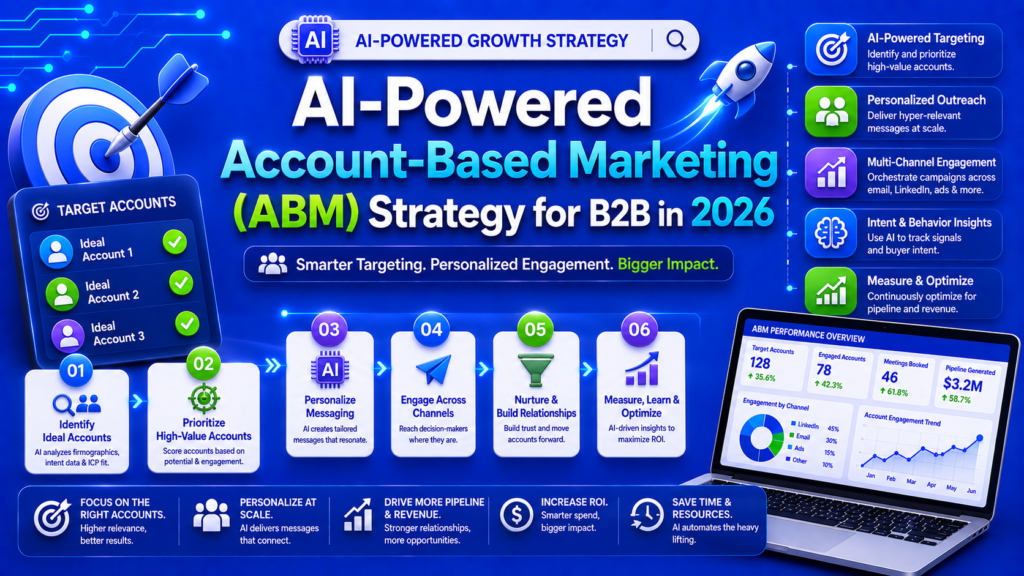
Featured Snippet Target: An AI-powered ABM strategy uses machine learning to: (1) identify high-value target accounts using predictive scoring and intent data, (2) create personalized content and messaging for each account, (3) orchestrate multi-channel engagement across ads, email, and sales outreach, and (4) measure account-level engagement and pipeline impact in real time.
Account-Based Marketing is not new. But AI-powered ABM is a fundamentally different animal than the manual, spreadsheet-driven ABM that most B2B companies attempted (and abandoned) over the past decade.
Traditional ABM failed because it required an enormous amount of manual work: researching accounts, crafting personalized content, coordinating sales and marketing touchpoints, and tracking engagement across channels. For most teams, the effort did not scale.
AI eliminates the scaling problem. The same level of personalization and coordination that previously required a team of 10 is now achievable with AI tools and a team of 2-3.
The AI-Powered ABM Framework
Phase 1: AI-Driven Account Selection
Traditional account selection: sales leadership picks 50 accounts based on gut feel and existing relationships.
AI-powered account selection: machine learning analyzes thousands of data points to score and rank accounts by likelihood to buy. Data inputs for AI account scoring:
- Firmographic data: company size, revenue, industry, growth rate
- Technographic data: technology stack, recent tool adoptions
- Intent data: what topics are they researching online?
- Engagement data: have they visited your website, downloaded content, attended events?
- Historical data: which account characteristics correlate with your best customers?
The AI scoring model produces:
- Tier 1 accounts (top 10%): highest propensity to buy, highest potential deal value
- Tier 2 accounts (next 20%): strong fit, moderate buying signals
- Tier 3 accounts (next 30%): good fit, early-stage interest
How many accounts to target:
|
Company Stage |
Tier 1 |
Tier 2 |
Tier 3 |
|---|---|---|---|
|
Early ABM |
10-25 |
25-50 |
50-100 |
|
Mature ABM |
25-50 |
50-100 |
100-250 |
|
Enterprise ABM |
50-100 |
100-250 |
250-500 |
Phase 2: Account Intelligence and Personalization
AI researches each target account and generates personalized marketing assets.
Account intelligence gathered automatically:
AI-generated personalized content:
- Custom landing pages addressing each account’s specific challenges
- Personalized email sequences referencing account-specific news and needs
- Targeted ad creative mentioning their industry, use case, or pain points
- Custom case studies matching their industry, size, and challenges
Phase 3: Multi-Channel Orchestrated Engagement
AI coordinates touchpoints across marketing and sales channels:
Week 1-2: Awareness
- LinkedIn Ads targeting employees at the account
- Display retargeting showing industry-relevant content
- Sales Navigator connection requests to key decision-makers
Week 3-4: Education
- Personalized email sequence from marketing
- LinkedIn InMail from sales with relevant case study
- Custom webinar invitation addressing their industry challenges
Week 5-6: Engagement
- Direct mail piece (yes, physical mail) with personalized messaging
- SDR call referencing specific challenges and content engagement
- Retargeting ads with demo/consultation CTA
Week 7-8: Conversion
- Meeting request from account executive
- Custom presentation addressing their specific needs
- ROI model built with their company’s data
Phase 4: Measurement and Optimization
ABM metrics differ from traditional demand gen metrics:
|
Metric |
What It Measures |
Target |
|---|---|---|
|
Account engagement score |
Total interactions across all channels |
Increasing monthly |
|
Account coverage |
% of buying committee reached |
>60% |
|
Pipeline velocity |
Speed from first touch to opportunity |
<60 days |
|
Deal size |
Average contract value from ABM accounts |
2-3x non-ABM deals |
|
Win rate |
% of ABM opportunities that close |
>30% |
|
Pipeline generated |
Total pipeline from ABM program |
Growing quarterly |
AI ABM Tools
Account identification and scoring:
- 6sense: Intent data and predictive account scoring
- Demandbase: ABM platform with account identification and orchestration
- ZoomInfo: Contact data and company intelligence
Personalization:
- Mutiny: Website personalization by account
- Folloze: Personalized content experiences per account
- PathFactory: AI-driven content journeys
Orchestration:
- HubSpot ABM: Account-based workflows and reporting
- Terminus: Multi-channel ABM advertising and orchestration
- RollWorks: Account-based advertising platform
Common ABM Mistakes
Mistake 1: Targeting too many accounts. ABM works because of focus. If you target 1,000 accounts, you are doing demand gen, not ABM. Start with 25-50 Tier 1 accounts.
Mistake 2: Marketing-only ABM. ABM fails without sales alignment. Marketing and sales must agree on target accounts, engagement signals, and handoff criteria.
Mistake 3: No personalization. If your ABM emails and ads look identical to your demand gen campaigns, you are not doing ABM. Account-specific messaging is what makes ABM work.
Mistake 4: Measuring the wrong things. ABM is about quality, not quantity. Measuring success by lead volume misses the point. Measure account engagement, pipeline value, and win rate.
The Bottom Line
AI-powered ABM is the most effective strategy for B2B companies selling to enterprise accounts. The combination of AI-driven account selection, automated personalization, and multi-channel orchestration creates a precision pipeline generation system.
At Expert Written Marketing, we build AI-powered ABM programs that target the right accounts with the right message through the right channels.
Ready to launch AI-powered ABM? Get started with Expert Written Marketing.