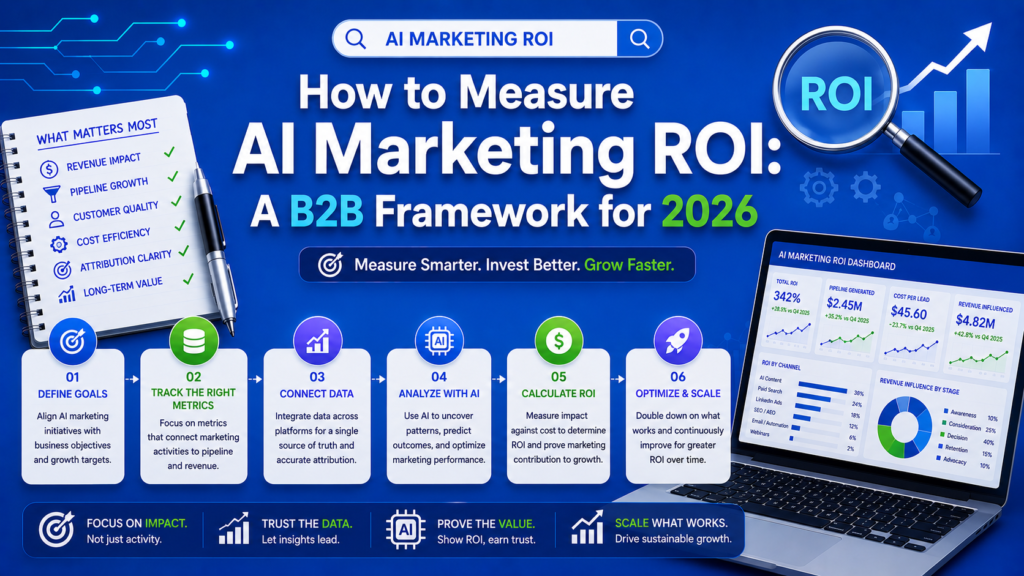
To measure AI marketing ROI, use this formula: AI Marketing ROI = (Revenue Attributed to AI Marketing − Total AI Marketing Investment) ÷ Total AI Marketing Investment × 100. Track three tiers: (1) efficiency metrics (time saved, cost per content piece), (2) performance metrics (lead quality improvement, conversion rate lift), and (3) revenue metrics (pipeline generated, deals closed, customer acquisition cost reduction).
“What’s the ROI of your AI marketing?” When your CFO asks this question—and they will—you need a better answer than “we’re getting more leads.”
Measuring AI marketing ROI is challenging because AI touches multiple systems, amplifies human effort, and generates value that is often indirect. But challenging is not impossible. You just need the right framework.
This guide gives you the exact measurement system we use at Expert Written Marketing to prove AI marketing’s impact on revenue. It is built for B2B companies where long sales cycles and multiple touchpoints make attribution complex.
Why Traditional ROI Measurement Fails for AI Marketing
Traditional marketing ROI is straightforward: spend $10,000, generate $50,000 in revenue, ROI is 400%.
Simple. AI marketing complicates this because AI creates value in ways that do not map neatly to a single revenue number:
Efficiency gains. Your content team produces 3x more content with AI assistance. How do you value the time saved?
Quality improvements. AI-optimized ad campaigns reduce cost per lead by 40%. The savings are real but spread across thousands of touchpoints.
Indirect attribution. AI chatbots qualify leads that eventually close via sales calls. Who gets credit, the chatbot or the salesperson?
Compound effects. AI-powered SEO content builds traffic over months. The full ROI is not visible until 6-12 months after the investment.
The Three-Tier AI Marketing ROI Framework
We measure AI marketing ROI across three tiers, from operational efficiency to bottom line revenue impact.
Tier 1: Efficiency ROI (The Quick Win)
Efficiency ROI measures how AI reduces costs and saves time in your existing marketing operations.
Metrics to track:
|
Metric |
How to Measure |
Example |
|
Content production time |
Hours per piece: before AI vs. after |
8 hours → 3 hours = 5 hours saved |
|
Content production cost |
Cost per piece: before vs. after |
$800 → $350 = $450 saved |
|
Ad optimization time |
Hours spent on manual bid adjustments |
10 hours/week → 2 hours/ week |
|
Email personalization |
Time to segment and custom‐ ize |
5 hours → 30 minutes |
|
Reporting time |
Hours building reports manu‐ ally |
8 hours/month → 1 hour/ month |
Calculating Efficiency ROI:
Monthly time saved × average hourly cost of marketing team = Monthly efficiency value
Example: 80 hours saved × $75/hour = $6,000/month efficiency value
Annual efficiency value: $72,000
AI tool costs: $24,000/year
Efficiency ROI: 200%
Why this matters: Efficiency ROI is the easiest to prove and the fastest to realize. Start here when building the case for AI marketing investment.
Tier 2: Performance ROI (The Growth Engine)
Performance ROI measures how AI improves marketing outcomes beyond what human-only execution achieves.
Metrics to track:
Lead quality improvement:
– MQL to SQL conversion rate: before AI vs. after AI
– SQL to Opportunity conversion rate
– Lead scoring accuracy (predicted vs. actual conversion)
Campaign performance lift:
– Google Ads: CPA reduction, ROAS improvement, conversion rate lift
– Email: open rate increase, click rate increase, unsubscribe rate reduction
– Content: organic traffic growth, keyword rankings gained, time on page
Personalization impact:
– Personalized vs. generic email conversion rates
– Website personalization conversion lift
– Dynamic content engagement rates
Calculating Performance ROI:
Additional leads generated by AI optimization × average deal value × close rate = Incremental revenue from AI performance improvements
Example:
– AI-optimized Google Ads generate 40 additional SQLs/month
– Average deal value: $25,000
– Close rate: 25%
– Monthly incremental revenue: 40 × $25,000 × 0.25 = $250,000
– Annual incremental revenue: $3,000,000
– AI marketing investment: $300,000
– Performance ROI: 900%
Tier 3: Revenue ROI (The Bottom Line)
Revenue ROI directly connects AI marketing activities to closed revenue. This is what your CFO cares about most.
The Revenue Attribution Model:
For B2B, use a weighted multi-touch attribution model that accounts for AI’s role at each stage:
First touch (20% credit): How did the prospect first discover your company? AI-powered SEO content, AI-optimized Google Ads, AI-targeted LinkedIn campaigns.
Lead nurture (30% credit): What touchpoints moved the prospect from lead to opportunity? AI-personalized email sequences, AI chatbot conversations, AI-recommended content.
Conversion (30% credit): What drove the final decision? AI-generated proposals, AI-powered demos, sales enablement tools.
Retention (20% credit): What keeps the customer engaged? AI-powered onboarding, automated check-ins, predictive churn alerts.
Building the AI Marketing Dashboard
Your CFO does not want a 50-page report. They want a one-page dashboard that answers three questions:
- How much did we spend on AI marketing?
- How much revenue did AI marketing generate?
- What is the trend?
The Executive Dashboard Layout
Section 1: Investment Summary
– Total AI marketing spend (tools + team + agency)
– Spend by category (content, ads, automation, analytics)
– Month-over-month trend
Section 2: Revenue Impact
– Pipeline generated by AI-influenced marketing
– Revenue closed from AI-influenced pipeline
– Customer acquisition cost (CAC) trend
– Marketing-sourced revenue as % of total revenue
Section 3: Efficiency Metrics
– Content pieces produced per month
– Cost per content piece trend
– Cost per qualified lead trend
– Marketing team output per person
Section 4: Leading Indicators
– Organic traffic growth
– Keyword rankings trajectory
– Email engagement trends
– Website conversion rate trend
Tools for Dashboard Creation
HubSpot reporting — for pipeline and revenue attribution
Google Looker Studio — for combining data from multiple sources
Google Analytics 4 — for website and conversion data
Google Ads reporting — for paid campaign performance
Setting Realistic ROI Expectations
AI marketing ROI is not instant. Set expectations with your leadership team:
|
Timeframe |
What to Expect |
|
Month 1-3 |
Efficiency gains visible. Performance improve‐ ments starting. Revenue ROI not yet measur‐ able. |
|
Month 3-6 |
Performance ROI becoming clear. First reven‐ ue attributable to AI marketing. Organic traffic growing. |
|
Month 6-12 |
Full revenue ROI measurable. Compound ef‐ fects of content and SEO visible. CAC declin‐ ing. |
|
Month 12+ |
AI marketing ROI should exceed 3:1. Systems are optimized and scaling. |
The benchmark: Successful B2B AI marketing programs achieve 3:1 to 10:1 ROI within 12 months. Programs that fail to reach 3:1 typically have issues with strategy, not with AI tools.
Common ROI Measurement Mistakes
Mistake 1: Measuring only tool costs. AI marketing ROI should include all costs: tools, team time, agency fees, and content production. Measuring only Clearscope’s $170/month subscription against total revenue gains is misleading.
Mistake 2: Expecting immediate revenue ROI. B2B sales cycles are 3-12 months. Content takes 3-6 months to rank. Set the measurement window accordingly.
Mistake 3: Ignoring efficiency value. Time saved is real money. If AI saves your marketing team 80 hours per month, that is $6,000+ in labor value even before counting revenue impact.
Mistake 4: Using last-touch attribution. Last-touch attribution gives all credit to the final touch-point before conversion, ignoring the content, ads, and nurture that built the relationship. Use multi-touch attribution.
Mistake 5: Not measuring incrementality. The key question is not “what did AI marketing pro‐
duce?” but “what did AI marketing produce that would not have happened without it?” Run controlled
experiments when possible.
The Bottom Line
AI marketing ROI is measurable—you just need the right framework. Start with efficiency metrics (easy, fast), build to performance metrics (powerful, clear), and ultimately connect to revenue metrics (the CFO’s language).
The companies that measure AI marketing ROI effectively invest more confidently, optimize faster, and outpace competitors who are flying blind.
At Expert Written Marketing, we build measurement systems alongside marketing strategies. Becauseif you cannot prove ROI, you cannot scale investment.
Need help measuring your marketing ROI? Get a free measurement audit (https://expertwrittenmarketing.com) from Expert Written Marketing.