
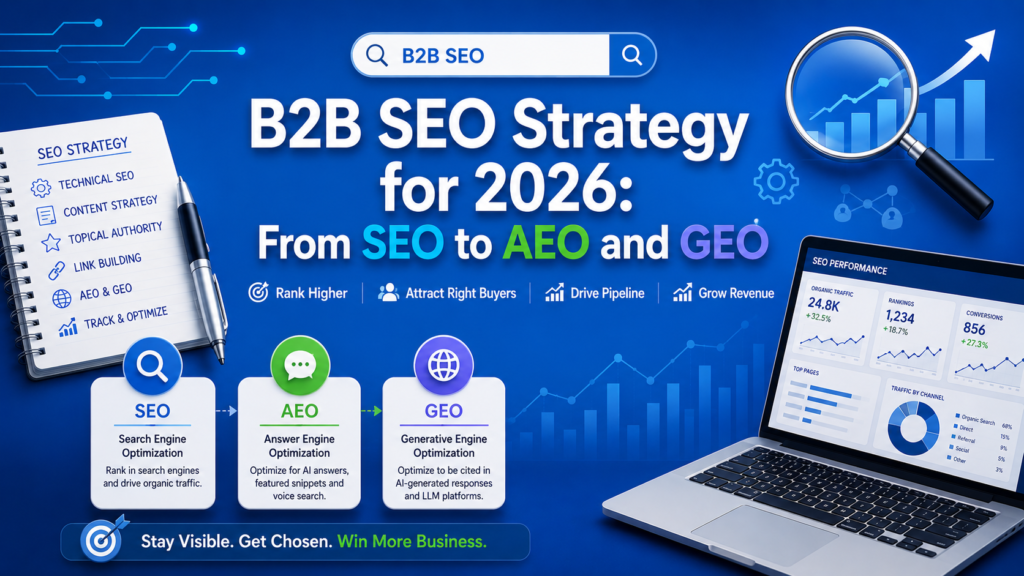
B2B SEO strategy in 2026 must go beyond traditional search optimization to include AEO (Answer Engine Optimization) for AI Overviews and featured snippets, and GEO (Generative Engine Optimization) for visibility in AI chatbots like ChatGPT and Perplexity. The winning approach combines technical SEO, topical authority through content clusters, and structured data to ensure your B2B brand appears in both traditional search results and AI-generated answers.
Traditional SEO—the kind where you research keywords, write blog posts, and build backlinks—is no longer enough for B2B companies. It still matters, but it is now one piece of a much larger puzzle.
In 2026, your prospects find information through three channels: Google Search (traditional), Google AI Overviews (AEO), and AI chatbots like ChatGPT, Perplexity, and Gemini (GEO). If your B2B SEO strategy does not address all three, you are invisible to a growing segment of your market.
This guide breaks down the complete B2B search visibility strategy for 2026—and the specific actions you need to take now.
The Search Landscape Has Fractured
Google still processes over 8.5 billion searches per day. But how those searches deliver answers has fundamentally changed.
Traditional organic results now appear below AI Overviews for many queries. Studies show AI Overviews reduce clicks to organic results by 25-40% for informational queries. Your page-one ranking may generate fewer clicks than it did two years ago.
AI Overviews synthesize information from multiple sources and present it directly in search results. Being cited as a source in AI Overviews is the new “position zero.”
AI chatbots are becoming primary research tools for B2B professionals. When a VP of Marketing asks
ChatGPT “what is the best AI marketing strategy for B2B,” the response influences their shortlist—and your brand may or may not be mentioned.
What This Means for B2B Companies
You need a three-layer strategy:
1. SEO — rank in traditional organic results (still the highest-volume channel)
2. AEO — get cited in Google AI Overviews and featured snippets
3. GEO — become a reference source for AI chatbots and generative engines
Layer 1: Modern B2B SEO (The Foundation)
Traditional SEO is not dead—it is the foundation everything else builds on.
Topical Authority: The #1 Ranking Factor for B2B
Google’s algorithms increasingly reward topical authority—comprehensive coverage of a subject—over individual keyword targeting. For B2B companies, this means building content clusters.
How to build a topic cluster:
1. Choose a pillar topic aligned with your core service. Example: “AI marketing for B2B”
2. Create a comprehensive pillar page (2,500+ words) covering the topic broadly
3. Build 10-15 cluster pages addressing specific subtopics: tools, strategy, ROI measurement, case studies, trends
4. Interlink everything. Every cluster page links to the pillar. The pillar links to every cluster page. Cluster pages link to related cluster pages.
The result: Google sees your site as the comprehensive authority on AI marketing for B2B, and rewards your entire cluster with higher rankings.
Technical SEO for B2B Sites
B2B websites often have technical issues that prevent ranking:
Site speed. B2B sites loaded with tracking scripts, chatbots, and third-party tools are often slow. Target Core Web Vitals scores in the “Good” range:
– Largest Contentful Paint (LCP): under 2.5 seconds
– Interaction to Next Paint (INP): under 200 milliseconds
– Cumulative Layout Shift (CLS): under 0.1
Crawlability. Ensure Google can access and index all important pages. Common B2B issues:
– Login-gated content blocking Googlebot
– JavaScript-rendered content not loading for crawlers
– Pagination issues on resource libraries
– Orphan pages with no internal links
Schema markup. Implement structured data for:
– Organization (company info, logo, social profiles)
– Article (author, publish date, modified date)
– FAQ (frequently asked questions on key pages)
– HowTo (step-by-step process content)
– BreadcrumbList (site navigation structure)
Link Building for B2B
Backlinks still matter, but the approach for B2B differs from consumer SEO.
High-value B2B link strategies:
– Original research. Conduct surveys, publish data reports, and create industry benchmarks. Data-driven content earns links naturally.
– Expert contributions. Get quoted in industry publications, contribute guest articles to authoritative B2B sites.
– Tool and template creation. Build free tools, calculators, or templates that other sites naturally reference and link to.
– Partnership content. Co-create content with technology partners, industry associations, and complementary service providers.
Avoid: Link buying, private blog networks, and low-quality directory submissions. Google’s spam detection is sophisticated enough to catch these, and the penalty is severe.
Layer 2: Answer Engine Optimization (AEO)
AEO targets Google’s AI Overviews and featured snippets—the answers that appear directly in search results.
How AI Overviews Select Sources
Google’s AI Overviews synthesize information from multiple web pages. To be cited as a source:
Provide clear, direct answers. AI Overviews prefer content that answers questions concisely before expanding into detail. Structure your content with a clear answer in the first paragraph, followed by supporting evidence and depth.
Use structured formatting. Numbered lists, comparison tables, and definition-style paragraphs are more likely to be extracted into AI Overviews. Format your content for easy parsing.
Demonstrate expertise. AI Overviews favor authoritative sources. Strong author bios, cited sources, and topical depth signal expertise to Google’s systems.
AEO Optimization Tactics
Target question-based queries. Identify People Also Ask questions for your keywords and answer them directly in your content. Use H2 or H3 headings that mirror the exact question format.
Create definition paragraphs. For every key concept in your content, include a one-to-two sentence definition that AI can extract. Start with the format: “[Term] is [clear definition].”
Build FAQ sections. Add structured FAQ sections (with FAQ schema markup) to your key pages. Each question should be answered in 40-60 words—long enough to be comprehensive, short enough to be extracted.
Comparison tables. For any “vs” or “best” content, include structured comparison tables. AI Overviews frequently extract tabular data.
Layer 3: Generative Engine Optimization (GEO)
GEO is the newest and most rapidly evolving layer. It targets AI chatbots—ChatGPT, Perplexity, Claude, Gemini—that B2B professionals increasingly use for research.
How AI Chatbots Select Sources
AI chatbots form their responses based on:
– Training data (what they learned during training)
– Real-time web browsing (Perplexity, ChatGPT with browsing)
– Source authority and brand mentions across the web
GEO Strategies for B2B
Brand mention saturation. The more your brand is mentioned across authoritative sources—industry publications, partner sites, review platforms—the more likely AI chatbots are to reference you. Invest in PR and thought leadership that generates mentions beyond your own website.
Become the cited source. When AI chatbots browse the web, they look for authoritative, well-structured content. Create content that is easy for AI to parse:
– Clear headings that describe the content
– Numbered steps for processes
– Data-backed claims with source citations
– Author credentials visible on the page
Optimize for conversational queries. AI chatbot users ask questions differently than Google searchers. They use natural language, ask follow-up questions, and request opinions. Create content that addresses conversational query patterns.
Claim your presence on knowledge platforms. Ensure your company has complete, accurate profiles on:
– Crunchbase
– G2, Capterra, TrustRadius (review sites)
– LinkedIn company page
– Wikipedia (if notable enough)
– Industry-specific directories
These platforms are heavily referenced by AI chatbots when answering questions about companies and services.
The Integrated B2B Search Strategy
Here is how all three layers work together:
Action | SEO Impact | AEO Impact | GEO Impact |
Content clusters | ★★★ | ★★ | ★★ |
Schema markup | ★★ | ★★★ | ★ |
FAQ sections | ★★ | ★★★ | ★★ |
Original research | ★★★ | ★★ | ★★★ |
Brand mentions/PR | ★★ | ★ | ★★★ |
Technical SEO | ★★★ | ★★ | ★ |
Review site presence | ★ | ★ | ★★★ |
Comparison tables | ★★ | ★★★ | ★★ |
The actions with the highest combined impact across all three layers: original research, content clusters, and FAQ sections with schema markup.
90-Day Implementation Plan
Month 1: Audit and Foundation
- Complete technical SEO audit and fix critical issues
- Identify 3 pillar topics aligned with your services
- Implement schema markup on all existing content
- Audit and optimize Google Business Profile and review site profiles
Month 2: Content Build
- Create first pillar page and 5 cluster pages
- Add FAQ sections with schema to top 20 trafficked pages
- Publish first original research piece or data report
- Begin PR outreach for brand mention building
Month 3: Optimize and Expand
- Analyze AI Overview citations for target keywords
- Optimize content structure based on AI extraction patterns
- Build second pillar page with cluster content
- Launch ongoing link building campaign
The Bottom Line
B2B SEO in 2026 is a three-dimensional game. Companies that only optimize for traditional search will see diminishing returns. Companies that build strategies spanning SEO, AEO, and GEO will capture more visibility, more traffic, and more pipeline than competitors stuck in the old paradigm.
At Expert Written Marketing, we build B2B search strategies that work across all three layers. Our clients do not just rank on Google—they appear in AI Overviews, get cited by chatbots, and become the default answer when their prospects search for solutions.
Ready to future-proof your B2B search presence? Start with a free SEO audit (https://expertwrittenmarketing.com) from Expert Written Marketing.

2 Comments
AI Marketing Trends 2026: Weekly Roundup - Expert Written Marketing
AI Marketing Weekly Roundup #3: Google Ads Updates and Content Ranking Changes - Expert Written Marketing
[…] Implement the AEO optimization tactics from our B2B SEO Strategy guide […]