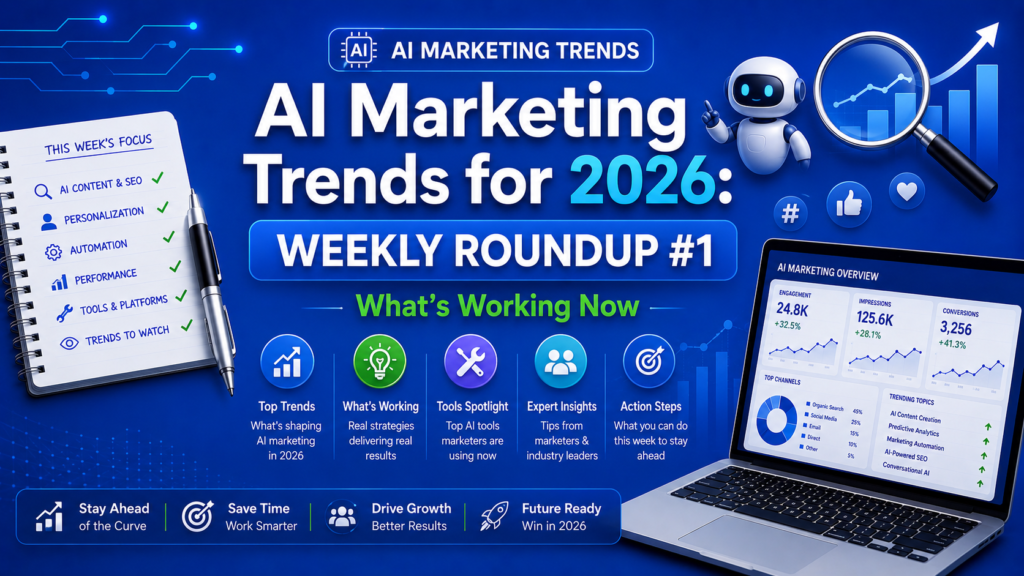
The top AI marketing trends for 2026 include: (1) Google AI Mode replacing 25% of traditional search clicks, (2) the shift from SEO to AEO (Answer Engine Optimization) and GEO (Generative Engine Optimization), (3) AI-powered personalization becoming standard for B2B, (4)video and short-form content dominating B2B engagement, and (5) first-party data strategies replacing third-party cookie dependence.
Welcome to Week 1 of the Expert Written Marketing AI Marketing Roundup. Every week, we distill the most important developments in AI and digital marketing into actionable intelligence for B2B marketers.
This is not a news aggregator. Every trend includes a “What to do about it” section so you can take action Monday morning.
Trend 1: Google AI Mode Is Reshaping Search Behavior
Google’s AI Mode, the conversational search experience that lets users ask follow-up questions and get synthesized answers is now available to all US users and expanding globally.
What is happening: Early data shows AI Mode is handling 15-20% of all Google searches. For informational queries, that number jumps to 30-40%. Users are increasingly asking complex, multi-part questions that AI Mode answers directly, reducing clicks to websites.
Impact on B2B marketing: Traditional organic click-through rates are declining for informational keywords. However, commercial and transactional queries are less affected—buyers still want to visit vendor websites when they are evaluating solutions.
What to do about it:
– Audit your top-performing keywords and check whether AI Overviews appear for them
– Restructure content to be cited in AI Overviews (clear definitions, structured data, FAQ schema)
– Shift content investment toward commercial-intent keywords that still drive clicks
– Begin tracking “AI Overview citations” as a new performance metric alongside rankings
Trend 2: The SEO → AEO → GEO Evolution Is Accelerating
The shift we predicted is happening faster than expected. B2B marketers who only optimize for traditional search are seeing traffic plateau or decline, while those implementing AEO and GEO strategies are capturing new visibility.
The data:
– Companies appearing in AI Overviews see 30% more brand awareness, even when users do not click
– Perplexity and ChatGPT are now the second and third most popular research tools among B2B professionals (after Google)
– Content cited by AI chatbots receives 2-3x more referral traffic than content that is not cited
What to do about it:
– Read our complete guide: B2B SEO Strategy for 2026: From SEO to AEO and GEO (/b2b-seo-strategy-2026)
– Start monitoring your brand mentions in ChatGPT and Perplexity responses
– Create content specifically structured for AI extraction (numbered lists, comparison tables, clear definitions)
– Build topical authority through content clusters rather than targeting individual keywords
Trend 3: AI-Powered Personalization Is No Longer
Optional Personalization has been a buzzword for years. In 2026, it has become a practical reality thanks to AI tools that make it implementable for companies of any size.
What has changed: AI personalization tools have dropped in price by 60% over the past two years while improving in capability. Website personalization, email personalization, and ad personalization that once required enterprise budgets are now accessible to mid-market B2B companies.
The benchmark data:
– Personalized B2B websites convert 3-5x higher than generic websites
– Personalized email sequences have 40% higher click rates
– Personalized ad campaigns reduce cost per acquisition by 30-50%
What to do about it:
– Start with email personalization (lowest cost, fastest implementation)
– Implement dynamic content on your website for your top 3 industry segments
– Use AI-powered tools like Mutiny or Clearbit to identify visitor companies and serve relevant content
– Test personalized ad creative on LinkedIn (industry-specific headlines and images)
Trend 4: Video Content Dominance in B2B
Video is no longer just “nice to have” for B2B companies. It is becoming the primary content format for several stages of the buyer journey.
The evidence:
– 72% of B2B buyers watch video content during their purchase research
– YouTube is the second largest search engine and the fastest-growing B2B research channel
– LinkedIn native video gets 5x more engagement than text posts
– Short-form video (under 3 minutes) generates 2x the engagement of long-form for top-of funnel awareness
What to do about it:
– Create a YouTube channel and publish at least one educational video per week
– Repurpose every blog post into a companion video (even a 3-5 minute summary)
– Test LinkedIn video posts and Instagram Reels for B2B audiences
– Use AI video tools to accelerate production—script generation, thumbnail creation, and caption editing
– Read our upcoming guide: AI Video Marketing for B2B (/ai-video-marketing-b2b)
Trend 5: First-Party Data Strategies Are Essential
Third-party cookie deprecation is fully in effect. B2B companies that did not build first-party data strategies are now flying blind on attribution and targeting.
What this means practically:
– Retargeting audiences are smaller and less precise
– Attribution models relying on third-party cookies are broken
– Lookalike audiences on advertising platforms are degraded
What to do about it:
– Build your email list aggressively through gated content, webinars, and tool access
– Implement server-side tracking (Google Tag Manager server-side) for more reliable data collection
– Use CRM-based audiences (customer match) for paid advertising targeting
– Invest in offline conversion tracking to maintain Google Ads optimization quality
– Explore contextual advertising as a complement to behavioral targeting
Quick Wins You Can Implement This Week
- Check AI Overviews for your top 5 keywords. Search them in Google and note whether AI Overviews appear, and whether your content is cited. If not, you know where to optimize.
- Set up a Perplexity alert. Search for your brand name in Perplexity weekly. Track whether your content is being cited in AI-generated answers.
- Add FAQ schema to your top 5 blog posts. This takes 30 minutes per post and dramatically increases your chances of appearing in AI Overviews and featured snippets.
- Record one video this week. Take your best-performing blog post and record a 5-minute video summary. Publish it on YouTube and LinkedIn. You do not need professional equipment—your phone and natural lighting are sufficient.
- Audit your email personalization. Are you sending the same emails to everyone? Segment your list by industry, company size, or engagement level and customize at least the subject line and opening paragraph.
What We Are Watching Next Week
- Google’s rumored changes to AI Overview source citation methodology
- LinkedIn’s new AI-powered campaign optimization features
- The latest data on B2B buyer behavior shifts in Q2 2026
- New AI marketing tools launched this month
The Bottom Line
The B2B marketing landscape is shifting faster than at any point in the past decade. AI is not just another tool, it is restructuring how buyers find, evaluate, and choose vendors. The companies that adapt fastest will capture disproportionate market share.
At Expert Written Marketing, we stay on top of every trend so our clients can focus on execution. Follow this weekly roundup for actionable intelligence delivered every week.
Want personalized recommendations for your B2B marketing? Book a free strategy call (https://expertwrittenmarketing.com) with Expert Written Marketing.