
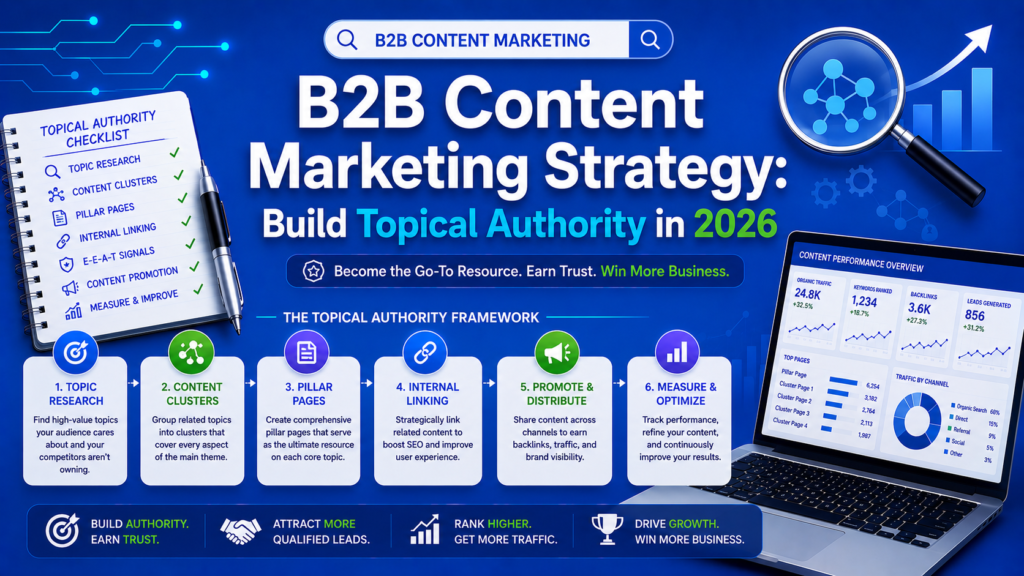
A B2B content marketing strategy in 2026 should use the pillar-cluster
model to build topical authority: create comprehensive pillar pages (2,500+ words) for core topics, surround each with 10-15 cluster articles targeting related keywords, and interlink everything. Combine this with multi-format content (blog, video, social, email), AI-assisted production, and data-drivendistribution to achieve consistent organic growth and pipeline generation.
Most B2B content strategies are what I call “random acts of content.” A blog post here, a whitepaper there, a social post when someone remembers. No system, no strategy, no compounding results.
The B2B companies winning at content marketing in 2026 treat it like engineering—systematic, data-driven, and built to compound over time.
This guide covers the complete B2B content marketing strategy framework: from planning through production through distribution through measurement. Every section includes the specific tactics we deploy for clients at Expert Written Marketing.
The Pillar-Cluster Content Model
The pillar-cluster model is the architecture that turns random content into a search authority engine.
How It Works
Pillar pages are comprehensive, authoritative pages covering a broad topic (2,500+ words). They rank for high-volume, competitive keywords.
Cluster articles are focused pages covering specific subtopics within the pillar topic (1,500-2,000 words). They rank for lower-volume, less competitive keywords.
Internal links connect everything. Every cluster article links to its pillar page. The pillar page links to every cluster article. Cluster articles link to related cluster articles.
The result: Google recognizes your site as the authority on the entire topic, not just individual keywords. Your entire cluster rises in rankings together.
Example Pillar-Cluster for a B2B Marketing Company
Pillar: “AI Marketing for B2B” (2,400 monthly searches)
Cluster articles:
– AI marketing tools for B2B (3,600 searches)
– AI content marketing strategy (1,600 searches)
– AI marketing ROI measurement (1,100 searches)
– AI email marketing for B2B (1,300 searches)
– AI marketing case study (720 searches)
– AI chatbots for B2B sales (1,300 searches)
– AI social media marketing B2B (1,600 searches)
– AI video marketing B2B (590 searches)
– AI personalization B2B (720 searches)
– AI marketing trends 2026 (2,900 searches)
Total cluster search volume: 17,830/month
One pillar with 10 cluster articles captures nearly 18,000 monthly searches. Build 3-5 pillars and you are targeting 50,000-90,000 monthly searches.
Building Your Pillar-Cluster Plan
Step 1: Identify 3-5 pillar topics aligned with your core services and your audience’s biggest challenges.
Step 2: Keyword research each pillar. Use Ahrefs or SEMrush to find all related keywords with search volume. Group them into clusters of closely related terms.
Step 3: Map each cluster keyword to a content piece. Define the title, format, and target word count for each article.
Step 4: Prioritize by opportunity. Start with clusters that have the most low-difficulty keywords—these rank faster and build momentum.
Step 5: Create a production calendar. One pillar page per month, 3-4 cluster articles per week.
Content Operations: The Production System
Strategy without execution is just a PowerPoint deck. Here is the production system that turns content strategy into published content consistently.
The Content Production Pipeline
Week 1: Research and planning
– AI tools analyze target keywords and competitor content
– Content strategist creates detailed content briefs
– Subject matter expert reviews briefs and adds unique angles
Week 2: Draft creation
– AI generates structured first drafts from content briefs
– Human writers enhance with expertise, examples, and voice
– First draft review and feedback
Week 3: Optimization and review
– SEO optimization using Clearscope or Surfer SEO
– Editorial review for quality, accuracy, and brand voice
– Graphic design for featured images and diagrams
Week 4: Publication and distribution
– Content published with full on-page SEO
– Distribution across email, social, and paid channels
– Internal linking updated on existing content
Team Structure for B2B Content
|
Role |
Responsibility |
Full-time or Fractional |
|
Content Strategist |
Keyword research, brief cre‐ ation, calendar management |
Full-time (8+ articles/month) |
|
Writer/Editor |
Draft creation, editing, quality assurance |
Full-time or agency |
|
SEO Specialist |
Technical SEO, optimization, rank tracking |
Fractional or agency |
|
Designer |
Graphics, carousels, in‐ fographics |
Fractional |
|
Subject Matter Expert |
Review, add expertise, ap‐ prove |
Part-time (2-3 hours/week) |
For lean teams: An agency like Expert Written Marketing can handle all roles except SME review, reducing your internal commitment to 2-3 hours per week.
Content Types That Drive B2B Pipeline
Not all content types are equal for B2B. Here is the hierarchy based on pipeline impact:
Tier 1: Pipeline Drivers (Highest Conversion)
Case studies. Nothing converts B2B buyers faster than proof that you have solved their exact problem for someone similar. Format: Problem → Solution → Results with specific numbers.
Comparison and alternative pages. “Your Product vs. Competitor” and “Best [Category] Tools” pages capture high-intent commercial searches. These pages directly influence purchase decisions.
ROI calculators and assessment tools. Interactive content that helps prospects quantify their problem and your solution’s value. These generate highly qualified leads.
Tier 2: Authority Builders (Drive Organic Traffic)
Comprehensive guides and pillar pages. These rank for competitive keywords and establish your brand as the authority. They generate top-of-funnel traffic that enters your nurture system.
Original research and data reports. Unique data earns backlinks, media coverage, and citations from other content creators. The link equity boosts your entire domain’s authority.
How-to tutorials. Step-by-step guides targeting specific problem-solving keywords. These attract prospects early in the buying journey.
Tier 3: Engagement Builders (Audience Growth)
Weekly roundups and trend reports. Keep your audience engaged and coming back regularly. Build email list subscribers.
Expert interviews and Q&A content. Feature industry leaders to borrow their audience and credibility.
Templates, checklists, and frameworks. Practical tools that prospects bookmark and share. Excellent for lead capture.
Content Distribution: The Amplification Strategy
Publishing is 50% of the work. Distribution is the other 50%.
Owned Channels
Email newsletter. Segment your list and send targeted content. New pillar guides get dedicated emails. Cluster articles go in weekly digests. Personalize subject lines and content recommendations using AI.
Social media. Repurpose every blog post into native content for each platform:
– LinkedIn: 3-5 key takeaways as a text post or carousel
– X/Twitter: Thread with main points and link to full article
– Instagram: Visual carousel or infographic
– YouTube: Video summary or companion deep-dive
Website. Add internal links from existing high-traffic pages to new content. Update older content with references to newer articles. Create “related content” widgets on every post.
Earned Channels
SEO. The primary long-term distribution channel. Optimization at publish time, then ongoing monitoring and refinement.
Backlink outreach. For pillar content and original research, proactively reach out to sites that link to competitor content on the same topic.
Guest contributions. Publish condensed versions or unique angles on industry publications with links back to your full content.
Paid Channels
Content promotion ads. Promote top-performing organic content through LinkedIn Ads and Google Ads to accelerate reach.
Retargeting. Serve content to website visitors who did not convert. Sequence from educational content → case study → conversion offer.
Measuring Content Marketing Success
Monthly Dashboard Metrics
Traffic metrics:
– Total organic sessions
– Organic sessions by content cluster
– New vs. returning visitors from organic
Engagement metrics:
– Average time on page by content type
– Pages per session from organic entry pages
– Scroll depth on key content
Conversion metrics:
– Leads generated from organic content
– Leads by content cluster
– Content-influenced pipeline (multi-touch attribution)
– Content-sourced closed revenue
SEO metrics:
– Keywords in top 3, top 10, top 50
– Featured snippet wins
– AI Overview citations
– Domain Authority/Rating trend
The Content Marketing ROI Calculation
Annual content investment: $120,000
(Agency: $8K/month + tools: $1K/month + internal time: $1K/month)
Annual results (Year 1):
– 45,000 monthly organic visitors × 12 = 540,000 annual visits
– 2% conversion rate = 10,800 leads
– 15% MQL rate = 1,620 MQLs
– 20% SQL rate = 324 SQLs
– 25% close rate = 81 new customers
– $15,000 average deal value = $1,215,000 revenue
Content Marketing ROI: ($1,215,000 – $120,000) / $120,000 = 912%
These numbers assume a 12-month ramp. Most programs see significant results starting in months.
The Bottom Line
B2B content marketing works when it is systematic, not sporadic. The pillar-cluster model builds compounding authority. AI-assisted production maintains quality at scale. Strategic distribution amplifies every piece of content.
At Expert Written Marketing, we build and execute B2B content marketing strategies that generate measurable pipeline. Our clients do not just publish content—they build organic growth engines.
Ready to build your content engine? Start with a free content audit (https://expertwrittenmarketing.com) from Expert Written Marketing.